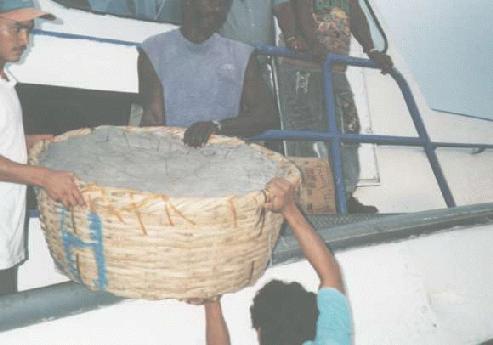
An older form of containerization in the port of Bluefields, Nicaragua(text of audio follows photo) |


|
|
|
| Photo: Peter Costantini | |
An older form of containerization in the port of Bluefields, Nicaragua(text of audio follows photo) |
|
|
|
|
| Photo: Peter Costantini | |
Narrator
In the face of the competition up and down the Americas, a Nicaraguan dry canal seems a long shot to some. United Nations transportation adviser Larry Burkhalter:
Larry Burkhalter
So what happens basically is, a ship if it has to pull into Los Angeles, California, with 18 million people in its immediate hinterland, or it pulls into Salina Cruz with 10,000 people in its hinterland, which one is it going to do? It will pull into Los Angeles, California, and then ship the extra containers, if a land bridge works, to the U.S. East Coast.
I think the Central American ports are in what I call a Bermuda Triangle. OK, if you look at the Central American isthmus, it has, what?, 29 or 30 million people. Quite frankly, for large 6,000 TEU vessels, that isn't even a market.
Narrator
TEU stands for twenty-foot equivalent unit, a standard measure of containers. Other observers, however, see unmet needs that such a route could fill. Jim Reese of the New Orleans Port Authority:
Jim Reese
There is probably some benefit to this idea in terms of the mega-ships that are being built right now. That's the hot topic. Where they're looking to go to a few large deep-water ports, and then feeder vessels will move containers to the smaller ports.
And if a mega-ship can bring in 6,000, 7,500 TEUs from Asia, and get them across the Isthmus into feeder vessels going north and south, this might be economically feasible and, or practical.
Narrator
Transport consultant Alan Harding:
Alan Harding
It is kind of interesting, because when you look at it, Japan is a long way north. And that's very close actually, isn't it, to you guys on the West Coast. And then if you start from Singapore, that's ... or Hong Kong, much further south. That would have an effect.
The question is where the main port will be, in which country. Well you've got Long Beach to the north and then I suppose you could say you've got Panama to the south. So you're looking in that space between those two points anyway.
Narration and interviews by Peter Costantini
|
|