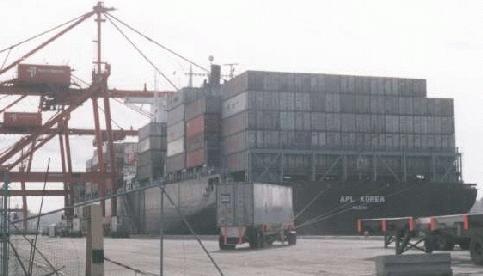
Unloading a post-Panamax container ship(text of audio follows photo) |


|
|
|
| Photo: Peter Costantini | |
Unloading a post-Panamax container ship(text of audio follows photo) |
|
|
|
|
| Photo: Peter Costantini | |
Narrator
As container trade rose on the floods of global commerce, the ships that carried the containers bulged, too. But the locks of the eighty-two year old Panama Canal remained a thousand feet long by a hundred and ten feet wide.
Global shipyards now have 36 orders for big new container ships that can't fit through the Canal. Many of these post-Panamax vessels, as they are called, already operate in either the Pacific or the Atlantic and Indian Oceans, transferring their cargo to rail or truck for shipment across North America.
Warren Crowther is a Costa Rica-based transport economist:
Warren Crowther
The universal marines with their post-Panamax boats, container ships, decided to concentrate on Long Beach and Oakland and Tacoma and Vancouver. You know, no dredging, lots of capacity, land transport already set up, and off you go.
They combined in transport two things that in other economic sectors are still held sometimes as being contradictory: just-in-time and economy of scale. And they make it work with very hefty investments. Turning Long Beach, I understand, into now, in terms of volume, the number one Pacific port of Mexico.
Narrator
The shipping companies, too, have bulked up. And as increased competition and volume push rates down, giants like Maersk of Denmark and Sea-Land of the U.S. have formed alliances or merged outright.
Narration and interviews by Peter Costantini
|
|