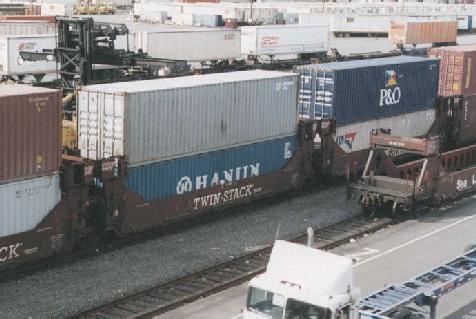
Double-stack railroad cars can carry two containers piggy-back.(text of audio follows photo) |


|
|
|
| Photo: Peter Costantini | |
Double-stack railroad cars can carry two containers piggy-back.(text of audio follows photo) |
|
|
|
|
| Photo: Peter Costantini | |
Narrator
Such technical and economic advances have made the U.S. land bridge, as the ship-to-train route is known, a fast and competitive method for moving goods across the continent. Over the past 30 years, the land bridge has skimmed off much of the Asian container traffic from the Panama Canal.
Jim Reese of the New Orleans Port Authority:
Jim Reese
Containerization and the efficiency of intermodal rail transfer made the West Coast a practical and financially economical method of transporting cargo, rather than coming through the Canal by water.
Narrator
Companies such as American President Lines and Sea-Land have developed seamless networks of ships, trains and trucks.
Emil Combe, an independent economic consultant:
Emil Combe
If you look at the whole movement of intermodal, the whole development of intermodal traffic in the United States, there's the example of how the steamship lines have gotten involved with in many cases running their own railroads, and basically controlling port-to-port transportation, well, ship-to-ship transportation, if you will.
Narrator
Recently, according to transport economist Warren Crowther, the Canadian Pacific railroad apparently backed away from an effort to challenge the U.S. land bridge.
Warren Crowther
They were moving out of Halifax and turning into Philadephia, and make a strong pitch for Philadelphia to become probably the number one Atlantic port of Canada. So they were buying up all the U.S. railroads to get both from Toronto and Montreal as close to and into Philadelphia through trackage rights, and they were vying for purchase of making large investments in port facilities in Philadelphia. It looked like the Canadians were going to go Vancouver to Philadelphia.
But apparently in the last year, Canadian Pacific has dropped that. They were selling out, and they have sold out all of their stuff east of Montreal.
And of course, with the U.S. mergers taking place, it could even be more difficult for anybody else to compete. Because then you'll have a one-carrier service across the States from Pacific to Atlantic. And I can see that all of this is causing the Canadians to take a new look at what they were doing. Well, if they're taking a new look at what they're doing, anybody else who wants to get into this game has to take a hard look, right?
Narration and interviews by Peter Costantini
|
|