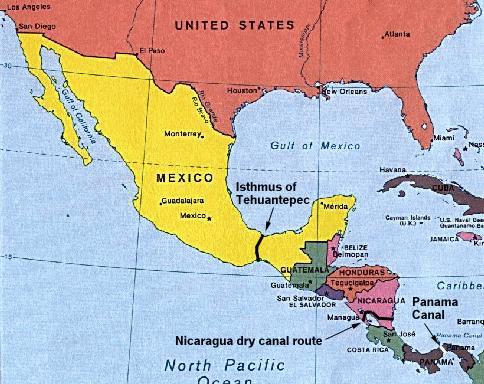
Existing and proposed transport routes across North and Central America(text of audio follows photo) |


|
|
|
| Map: | |
Existing and proposed transport routes across North and Central America(text of audio follows photo) |
|
|
|
|
| Map: | |
Narrator
Despite the dynamism of the U.S. land bridge, the container trade's growth and the Canal's limitations have spurred a search for alternate routes, according to economic consultant Emil Combe:
Emil Combe
The canal has some major inefficiencies in it. And those inefficiencies are: queueing time, just to get through the canal, for the ships that can fit through the Canal, and the inability to use the post-Panamax ships to get through the Canal, because they don't go through the canal. And so that means that you've got to create an intermodal connection across somewhere between the United States and Central America.
Narrator
Other all-water routes have grown rapidly in recent years. Captain Karsten Lemke of Zim American-Israeli Shipping Company:
Captain Karsten Lemke
There's a new phenomena coming up now, it's that we will have the "reverse land bridge," I call it that way because the original land bridge of course originated on the West Coast and went inland of the Rocky Mountains. This is now coming into a reverse process that because of the Suez opening up, of course container lines do combine and use their rail cars that are out on the East Coast with traffic that originated in the Far East.
Twenty percent of the Southeast Asia traffic is presently moving via Suez to the East Coast. It is sizably going to increase, and within the next 2 to 3 years we expect that this will be 40 percent.
Narrator
And while East-West trade still dominates, trade between North America and Latin America is on the upswing, says Joaquin Montalván, vice president of American President Lines:
Joaquín Montalván
I think it is an area of growth, which I think is driven by the realization on the U.S. side that these are markets that by the accident of geography are immediately adjacent to us, and that these are places where we have traditionally enjoyed favorable trade balances from the U.S. And with the formation of trading blocs in Asia and in Europe, I think that it is logical to assume that our orientation in the U.S. will gradually shift more and more to Latin America.
Narration and interviews by Peter Costantini
|
|