Panama and the Canal(text of audio follows photo) |


|
|
|
Panama and the Canal(text of audio follows photo) |
|
|
|
|
Narrator
Most countries from Mexico through Central America down to Colombia have floated dry or wet canal ideas. But only Panama and Nicaragua have advanced into serious planning. In this race, Panama has some natural and historical advantages.
The first dry canal crossed Panama over three centuries before the big ditch was finished in 1914, says Alan Harding, an independent transport consultant:
Alan Harding
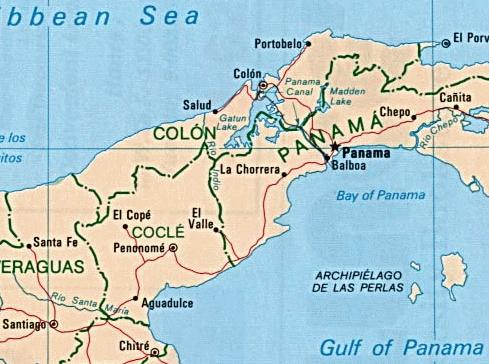
There's a place in Panama called Portobelo, it's on the Caribbean end, which is the old Spanish port. And they used to bring the gold up from Peru, and then ship it across the isthmus on a burro, mule or something to Portobelo. There's a very big warehouse there where they're supposed to have kept all this stuff and then sent it off to Spain. So that was the first land bridge.
Narrator
Today, Panama is privatizing and upgrading its ports and its old railroad to capture the spill-over container traffic from the Canal. The congested waterway is raising its tolls over 16 percent between 1996 and 1998. Rex Sherman of the American Association of Port Authorities:
Rex Sherman
Some of the very largest carriers, Evergreen, for example, and some others, are building some very modern container facilities in Panama right now. So what I'm saying is a lot of money, Evergreen, that's the world's largest container ship operator, is committing itself to Panama, and I don't know that they'd want to divert business away from their own facility through Nicaragua.
Narrator
Last year, Panama awarded a contract to Hutchison Port Holdings of Hong Kong to build port facilities at both ends of the Canal. Kansas City Southern Industries is also negotiating with the government on a concession to rebuild the railroad between the ports, says KCSI assistant vice president William Galligan:
William Galligan
The theory behind our operation, what it would be, is that we would run this train service almost like a conveyor belt, almost like a subway system. That it would just keep on going. The ports would unload cargo from the ships, and would leave it on the docks, and it would be loaded onto our train and it would just take off.
Really our trains are almost like subway-type things, there'd be engines on both ends. So it would be unloaded on the other side, loads taken on there, and then brought back. And it would be done just continuously like that.
Narration and interviews by Peter Costantini
|
|